
Fire Alarm Categories Explained: L1–L5, M, P1–P2 (Simple Guide)
Fire alarm categories L1, L2, and L3 are the most commonly searched terms when people try to understand UK fire alarm coverage and compliance.
In simple terms:
- “L” categories are mainly about life protection (helping people escape)
- “P” categories are mainly about property protection (reducing damage and business interruption)
- “M” means manual (manual call points) — usually combined with an L or P design
In this guide, we break down fire alarm categories L1, L2, and L3 first, then explain L4, L5, and the property categories P1 and P2.
This guide explains what each category typically means, where it’s commonly used, and what to ask your installer or maintenance provider.
For general UK guidance on fire safety responsibilities, use this single reference.
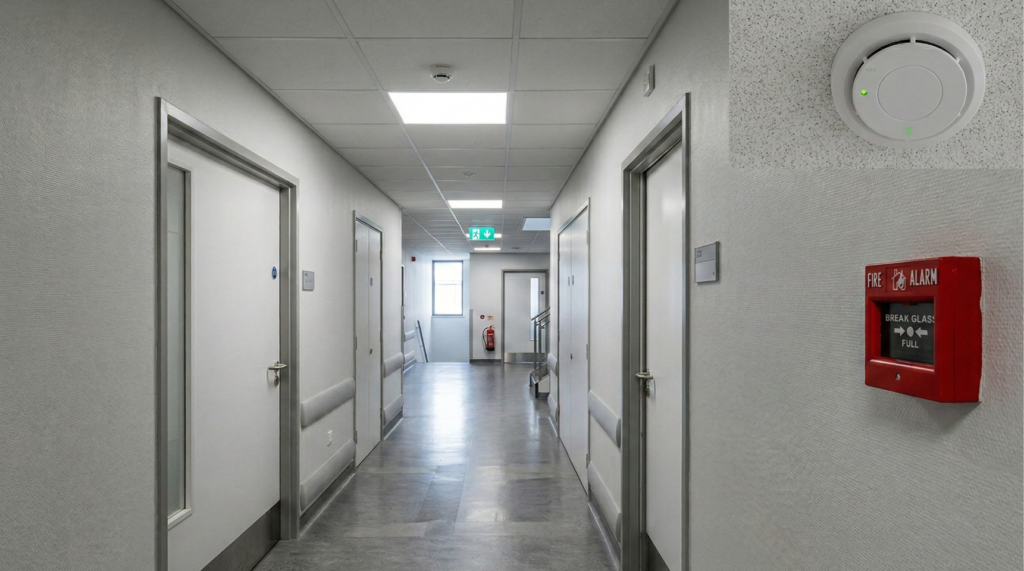
What do fire alarm categories mean?
Fire alarm categories describe the extent and purpose of automatic detection in a building.
They are chosen based on:
- The building use (e.g., HMO, office, shop, warehouse)
- Sleeping risk and evacuation strategy
- Fire risk assessment findings
- Layout and escape routes
- Fire load and business continuity needs
Important: The “right” category should be justified by a Fire Risk Assessment (FRA) and competent design, not guesswork.
L categories (Life protection): L1 to L5
L1 – Maximum life protection
Typical meaning: Automatic detection throughout the building (all areas), plus manual call points and sounders.
Where you often see it: HMOs, care settings, hotels, complex buildings, high sleeping risk.
Why it’s used: Early warning anywhere in the building gives occupants maximum time to escape.
L2 – Additional life protection
Typical meaning: Detection in escape routes plus high-risk areas (e.g., kitchens, plant rooms, boiler rooms), plus manual call points.
Where you often see it: Houses in multiple occupation (depending on risk), larger HMOs, certain mixed-use buildings.
Why it’s used: Targets higher-risk rooms to provide earlier warning.
L3 – Standard life protection
Typical meaning: Detection on escape routes and rooms opening onto escape routes, plus manual call points.
Where you often see it: Offices, schools, and typical commercial buildings.
Why it’s used: Provides early warning so people can use escape routes safely.
L4 – Modest life protection
Typical meaning: Detection only on escape routes (stairs/corridors), plus manual call points.
Where you often see it: Lower-risk buildings where room detection isn’t required.
Key limitation: A fire could develop in a room before it’s detected on the escape route.
L5 – Localised life protection
Typical meaning: A custom design to protect a specific risk area, based on the FRA.
Where you often see it: A single high-risk room or a specific hazard requiring detection beyond the main category.
Note: L5 is not “better” or “worse” — it’s “specific”.
P categories (Property protection): P1 and P2
P1 – Maximum property protection
Typical meaning: Automatic detection throughout the building to reduce damage and downtime.
Where you often see it: Warehouses, factories, critical operations, sites where business interruption is a major risk.
P2 – Minimum property protection
Typical meaning: Detection only in defined high-risk areas to reduce the chance of a major loss.
Where you often see it: Lower-risk commercial sites that still want some property protection focus.
What does “M” mean (Manual)?
Category M refers to a manual-only system (manual call points and sounders). In practice, many systems are described as combinations such as:
- L3/M (life protection L3 with manual call points)
- L2/M
- P1/M etc.
Most real-world systems include manual call points, even when automatic detection is present.
Common mistakes we see on sites
- Choosing a category without an up-to-date Fire Risk Assessment
- Assuming L1 is always required (it isn’t)
- Using the wrong detector type for the environment (leading to false alarms)
- Treating “disablements” as normal when nuisance activations occur
- Not aligning the design with the building’s evacuation strategy
What to ask before you accept a quote or upgrade
- What category is recommended — and why (what does the FRA say)?
- Which areas are covered by detection (escape routes, rooms, high-risk areas)?
- Any constraints: ceiling heights, voids, special risks?
- How will false alarms be managed (device type/positioning)?
- What servicing and testing is included?
If you’re planning works or a major change, the right sequence is usually:
FRA → design → install/upgrade → commissioning → maintenance plan
FAQs
What is the difference between L3 and L2 fire alarm categories?
L3 generally covers escape routes and rooms opening onto them. L2 adds detection in additional high-risk areas (as identified by the FRA) to give earlier warning.
Is L1 always required for an HMO?
Not always. Many HMOs do require high levels of detection, but the correct category depends on the building layout, sleeping risk, and the FRA. Avoid assumptions.
What does P1 mean on a fire alarm system?
P1 usually means detection throughout the building for property protection and reduced business interruption.
Can I have both life and property protection?
Yes. Systems are often designed to satisfy life protection (L) and can also support property protection objectives depending on coverage and signalling arrangements.
Who decides the fire alarm category?
It should be based on the Fire Risk Assessment and competent design. The Responsible Person is accountable for ensuring the system is suitable and maintained.
If you’re unsure which fire alarm categories L1 L2 L3 apply to your building, the correct answer should come from the Fire Risk Assessment and a competent design review.
Contact us
Not sure which fire alarm category your building needs?
If you’re unsure whether you need L2, L3, L1, or a property protection approach like P1/P2, we can help you make sense of what’s appropriate for your building and risk profile. VMT Solutions Ltd provides fire alarm servicing and support across Telford, Shropshire and the wider West Midlands.
Get in touch:
- Call: 07955 220516
- Email: [email protected]
- Contact form
If you already have an FRA, send it over — it helps us advise accurately and avoid unnecessary upgrades.